
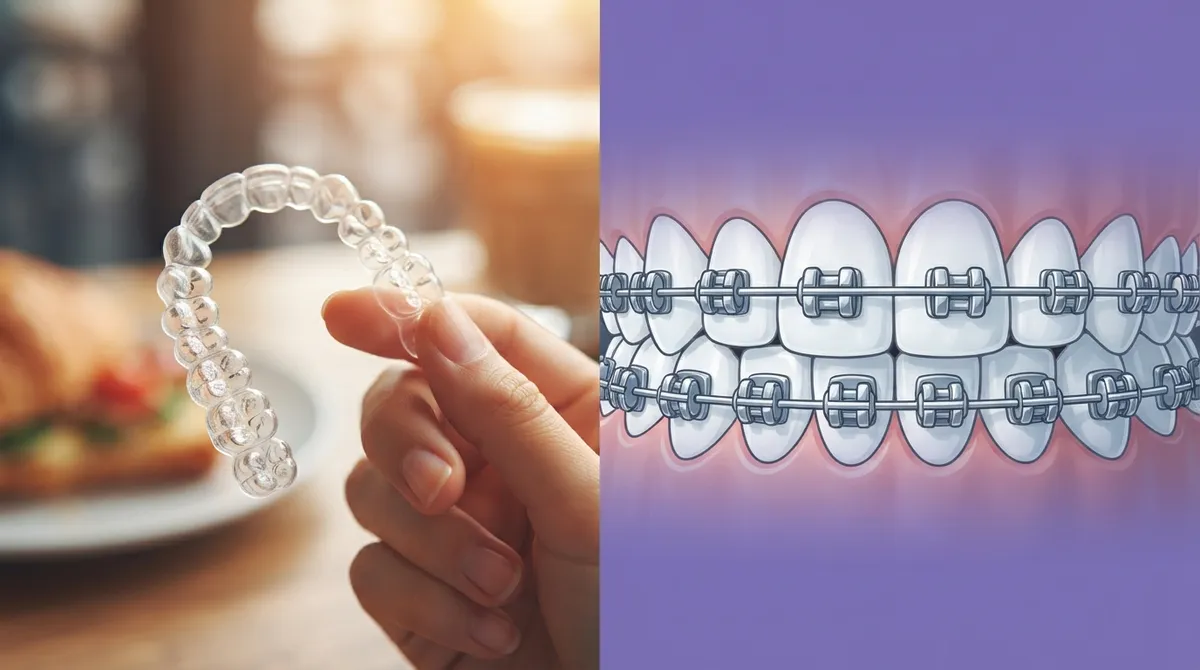
Key Takeaways
-
Clear aligners require 20-22 hours daily wear to be effective, making them unsuitable for forgetful patients or those who frequently eat out, while braces work passively without daily compliance needed.
-
Braces are more predictable for complex cases involving severe crowding, tooth rotation, bite adjustments, and torque control, while aligners work best for mild to moderate crowding and spacing issues.
-
Clear aligners are nearly invisible and allow normal eating without food restrictions, making them ideal for working professionals concerned about appearance, while braces are visible but require no daily management decisions.
-
Research shows both treatments are generally effective, but aligners have limited evidence for certain outcomes like tooth torque and ideal bite contacts compared to fixed braces.
-
Retainer wear after treatment completion is equally critical for both options to prevent teeth from drifting back, and skipping this step is one of the most common patient regrets.
-
Treatment time depends on case complexity and patient compliance rather than the appliance type alone, and both options cause manageable soreness that typically fades within days.
Standing in front of the mirror, thinking about crooked teeth, you probably have one big question: clear aligners or braces? You are not alone. Every week, parents, teens, and busy adults walk into our Brandon office asking the exact same thing. The good news? There is no wrong answer here, just the right answer for your smile, your lifestyle, and your goals.
This guide breaks down five key ways to compare clear aligners vs braces so you can make a confident choice. We will look at real facts, not hype, so you know what to expect before you commit. Whether you are a parent watching your child’s teeth come in crooked, a teen who wants to smile big in photos, or a working professional who cannot show up to meetings with a mouth full of metal, we have you covered.
Let’s walk through this together, one simple comparison at a time.
1. Compare How Each Option Actually Works
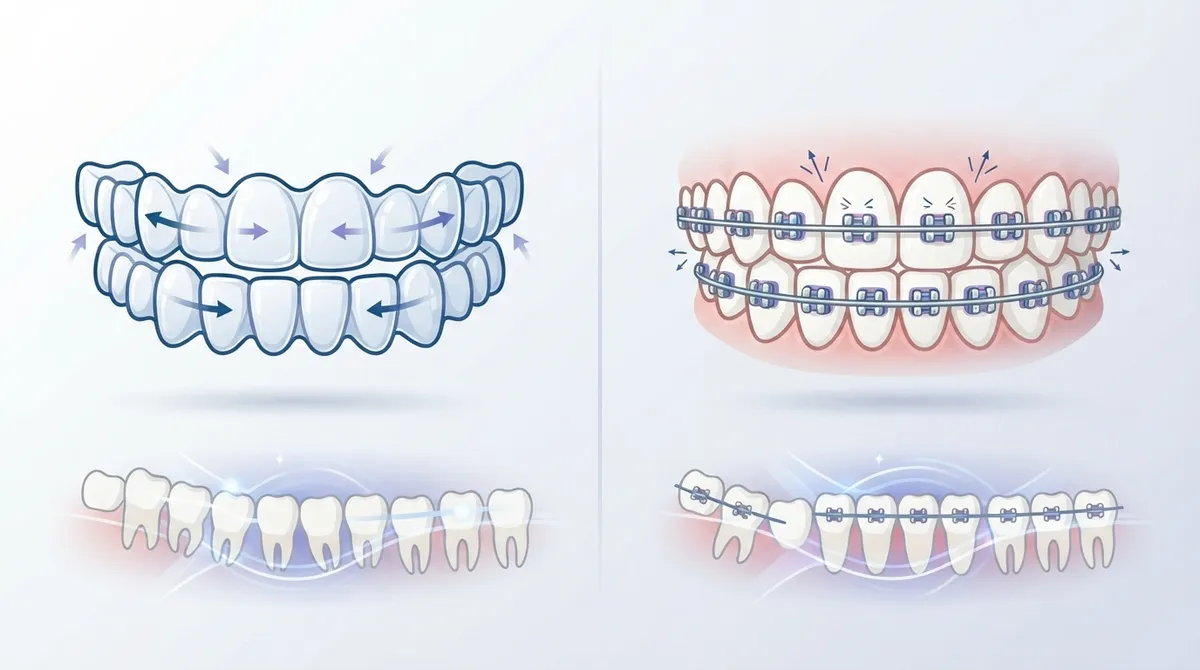
Clear aligners are custom-made, see-through trays that fit snugly over your teeth. You wear one set for a week or two, then switch to the next set in the series. Each tray nudges your teeth a tiny bit closer to their final position. Braces work differently. Metal or ceramic brackets get glued to each tooth, then a wire connects them all. That wire applies steady pressure over time to shift teeth into place.
Both methods can fix many of the same problems, like crowding, gaps, and bite issues. But your orthodontist will pick the option that matches your specific diagnosis. If you want to understand teeth positioning and fix alignment issues, a full exam is always the first step.
Key Differences at a Glance
Here is a simple table to help you see how these two options stack up side by side.
| Feature | Clear Aligners | Traditional Braces |
|---|---|---|
| Visibility | Nearly invisible | Visible metal or ceramic |
| Removable | Yes, for eating and brushing | No, fixed in place |
| Daily wear time | 20-22 hours per day | 24 hours, always on |
| Food restrictions | None once removed | Avoid hard, sticky foods |
| Best for | Mild to moderate cases | Complex or severe cases |
Curious how these clear trays actually straighten teeth step by step? Check out this guide on how clear trays straighten your smile for more detail.

2. Weigh the Commitment Level You Can Handle
Here’s something a lot of people do not think about: clear aligners only work if you actually wear them. The American Association of Orthodontists notes that aligners should be worn at least 22 hours a day for best results. That means popping them out only to eat, brush, and floss.
If you know you will forget to put your trays back in after lunch, or you tend to lose things, that is important to consider. Braces do not ask anything of you day to day. They stay put and keep working, whether you remember them or not.
Ask yourself these questions before deciding:
- Can I realistically commit to wearing trays 20 plus hours daily?
- Do I travel often or eat out a lot, making tray removal tricky?
- Am I comfortable with a fixed appliance that needs no daily decisions?
- Will I remember to bring my aligner case everywhere I go?
Teens juggling sports, band practice, and social life often do well with braces since there is nothing to remember. Meanwhile, adult professionals who attend client meetings may prefer the discretion of aligners, as long as they can stay disciplined. If you are weighing this decision for a teenager, this article on what’s best for your teen digs deeper into that specific age group.
3. Think About How Noticeable You Want Treatment to Be
Let’s be honest, appearance matters. Many adults avoid orthodontic treatment for years because they do not want a mouth full of metal during important career years. Clear aligners solve that problem beautifully. They are nearly invisible, so coworkers and clients may not even notice you are in treatment.
That said, modern braces have come a long way too. Ceramic braces blend in with your teeth, and colorful bands let kids and teens express their personality. If discretion is your top priority, though, aligners usually win this round.
Working professionals in the Brandon area often ask us about low-profile options that fit their busy careers. We always recommend exploring adult orthodontics options that straighten teeth at any age so you can find something that fits your daily routine without disrupting it.
4. Consider Case Complexity and Treatment Predictability
This is where things get a little more nuanced, and honestly, it is the part people skip over the most. A 2024 systematic review published in the Journal of Orthodontic Science looked at five separate studies comparing aligners to fixed braces. The review found that aligners can be an effective alternative for many patients, but it also noted limited evidence overall, and that some difficult cases may not respond as well to aligner treatment.
A separate 2019 systematic review, which pooled data from eight comparative studies, found both treatment types work well in general. However, it noted aligners may be less effective for certain outcomes, including tooth torque and achieving ideal bite contacts. Braces tend to offer more predictable control when teeth need complex rotation or when a bite needs significant adjustment.
Here are some signs that braces might be the stronger choice for your case:
- Severe crowding where teeth overlap significantly
- Complex bite problems involving the jaw
- Teeth that need rotation or vertical movement
- Multiple teeth requiring precise torque control
And here are signs clear aligners could be a great fit:
- Mild to moderate crowding or spacing
- Minor bite adjustments
- A strong desire for a removable, low-visibility option
- Good track record of following instructions consistently
No single case is exactly like another, which is why a proper orthodontic exam matters so much. If you are dealing with a specific bite issue, this comparison of overbite treatment options between braces and aligners offers helpful context.
5. Factor in Cost, Comfort, and Aftercare
Money matters, and so does comfort. Both treatments come with a range of costs depending on your case complexity, treatment length, and insurance coverage. Many practices, including ours, offer flexible payment plans to help spread out the investment over time.
As for comfort, both options can cause some soreness, especially right after adjustments or when switching to a new aligner tray. Braces may cause more irritation to cheeks and lips early on, while aligners can feel tight when you first put in a new set. Neither is painless, but neither is unbearable either. Most patients adjust within a few days.
Aftercare is where people often get surprised. Both treatments require a retainer afterward to keep your new smile in place. Teeth naturally want to shift back over time, so skipping your retainer is a common mistake. Learn more about how to keep your smile straight for life with the right retainer routine.
Here is a quick numbered breakdown of what happens after active treatment ends:
- Your orthodontist takes final scans or impressions of your teeth
- A custom retainer is made just for your smile
- You wear it full-time for a period, then switch to nights only
- Regular check-ins help make sure your teeth stay put
Skipping this step is one of the most common regrets we hear about at our Brandon office, so please do not skip it.
Why Bilingual, Personalized Care Makes a Difference
Choosing between clear aligners vs braces is a personal decision, and it deserves personal attention. At Chacon Orthodontics, Dr. Omar Chacon and his team offer care in both English and Spanish, making sure families throughout Westchase and Brandon feel fully understood every step of the way. This matters more than people realize. Clear communication builds trust, and trust makes treatment go smoother.
Dr. Chacon uses advanced 3D digital imaging to map out your treatment before it even begins, so you know what to expect from day one. You can follow along with real patient stories and smile transformations on Instagram, or connect with the practice on Facebook for updates and tips. Dr. Chacon’s professional background and credentials are also detailed on LinkedIn, if you want to learn more about his training and experience.
If you want to see what real patients in the area are saying, feel free to visit us on Google — Chacon Orthodontics Brandon and read their firsthand experiences.
Making Your Final Decision
At the end of the day, clear aligners vs braces is not about which one is universally better. It is about which one fits your teeth, your habits, and your life right now. A teen heading into football season might prefer braces for their durability. A parent noticing early signs of crowding in their child might want to explore early signs you need braces and what parents should look for. An adult professional prepping for a big presentation season might lean toward aligners for their subtlety.
Whatever your situation, the smartest first step is a real conversation with a board-certified orthodontist who can look at your teeth, listen to your goals, and map out a plan that actually works for you. Guessing online only gets you so far.
Ready to figure out which option fits your smile best? Schedule your free consultation with Dr. Chacon and his team today, and let’s build a plan that fits your life, not the other way around.
FAQs
Q: Are clear aligners as effective as braces?
A: For many mild to moderate cases, clear aligners can work just as well as braces. But for complex movements like tooth rotation or bite adjustments, braces sometimes offer more predictable results. Your best bet is a full exam so your orthodontist can tell you honestly which option fits your specific smile.
Q: Which is faster: clear aligners or braces?
A: There is no simple answer here since treatment time depends on your case, not just the appliance you choose. Some studies show aligners finishing a bit faster in certain situations, but consistency matters just as much as the tool itself. Wearing your aligners as directed makes a huge difference in how quickly you see results.
Q: Do clear aligners hurt more or less than braces?
A: Both treatments can cause some soreness, just in different ways. Braces might irritate your cheeks and lips at first, while new aligner trays can feel tight for a day or two. Most people find the discomfort manageable and it fades quickly as you get used to treatment.
Q: Can I eat and drink normally with clear aligners?
A: Yes, and this is one of the biggest perks people love. Just pop your trays out before meals, then brush before putting them back in. You will want to stick to water while wearing them, since other drinks can cause staining or sneak in around the edges.
Q: Do I need to wear a retainer after aligners or braces?
A: Absolutely, and this step is not optional if you want your results to last. Teeth naturally drift back toward their old positions without a retainer holding them in place. Whether you finish with braces or aligners, your orthodontist will create a custom retainer plan just for you.





