
Key Takeaways
-
Only fewer than 30% of orthodontists in the US are board certified, making it a significant differentiator that reflects voluntary commitment to excellence beyond basic licensing requirements.
-
Board certified orthodontists must complete dental school, a 2-3 year residency, pass a 240-question written exam, submit detailed clinical cases, undergo expert panel evaluation, and recertify every 10 years.
-
Board certification ensures higher diagnostic accuracy, better treatment planning, verified ethical standards, and ongoing education—directly improving patient outcomes across all age groups and treatment complexities.
-
You can verify board certification by asking the practice directly, checking the ABO's public directory, looking for the ABO logo on their website, or reviewing their credentials page.
-
Board certification is entirely voluntary and not required by law; it represents additional effort beyond state licensure to demonstrate proven clinical skill through rigorous evaluation by expert panels.
-
Board certified orthodontists are especially beneficial for young children needing early evaluation, teens with complex growth patterns, adults with bone density concerns, and patients with complex bite issues requiring advanced planning.
When you search for orthodontic care, you will likely see the term “board certified orthodontist” on many practice websites. But what does it actually mean? And why should it influence your decision? Understanding this credential can help you make a smarter choice for your smile — and for your family’s long-term oral health.
Not every orthodontist who treats patients has achieved board certification. In fact, fewer than 30% of orthodontists in the United States hold this distinction. It represents a voluntary commitment to excellence that goes well beyond the requirements for a basic license to practice. For patients in Westchase, Brandon, and the greater Tampa Bay area, knowing what this credential means can make all the difference in the quality of care you receive.
This article will walk you through everything you need to know — from what board certification is, to why it matters, to how to find a qualified provider near you.

What Is a Board Certified Orthodontist?
A board certified orthodontist is a dental specialist who has completed advanced training and voluntarily passed rigorous examinations administered by the American Association of Orthodontists-recognized credentialing body — the American Board of Orthodontics (ABO). The ABO was established in 1929 and holds the distinction of being the first specialty board in all of dentistry.
To become board certified, an orthodontist must go through a multi-step process that tests both knowledge and real-world clinical skill. This is not a simple online test. It requires years of preparation, detailed case submissions, and evaluation by expert panels. The American Dental Association recognizes the ABO as the only accredited specialty board in orthodontics.
Learn more about why choosing a board certified orthodontist makes all the difference in your treatment outcomes.

The Path to Becoming Board Certified
The journey to board certification is long and demanding. Here is a clear breakdown of the steps every board certified orthodontist must complete:
- Complete a four-year dental degree — Candidates must first earn either a Doctor of Dental Surgery (DDS) or Doctor of Dental Medicine (DMD) degree from an accredited dental school.
- Finish a 2-3 year orthodontic residency — After dental school, candidates must complete a CODA-accredited orthodontic specialty residency program. This is where they develop advanced skills in diagnosing and treating complex bite and alignment issues.
- Pass a comprehensive written examination — The ABO written exam includes 240 questions covering a wide range of orthodontic knowledge, from biomechanics to treatment planning.
- Submit detailed clinical case studies — Candidates must document real patient cases, demonstrating their ability to plan and execute effective orthodontic treatment.
- Pass clinical and oral evaluations — Expert panels review submitted cases and conduct oral examinations to confirm the candidate’s judgment, ethics, and clinical skill.
- Recertify every 10 years — Board certification is not permanent. Orthodontists must pass renewal examinations every decade to maintain their status and stay current with advances in the field.
This process ensures that board certified orthodontists are not just trained — they are rigorously evaluated and consistently held to the highest standards of care. You can explore more about what qualifications to look for when you find the best orthodontist near you.
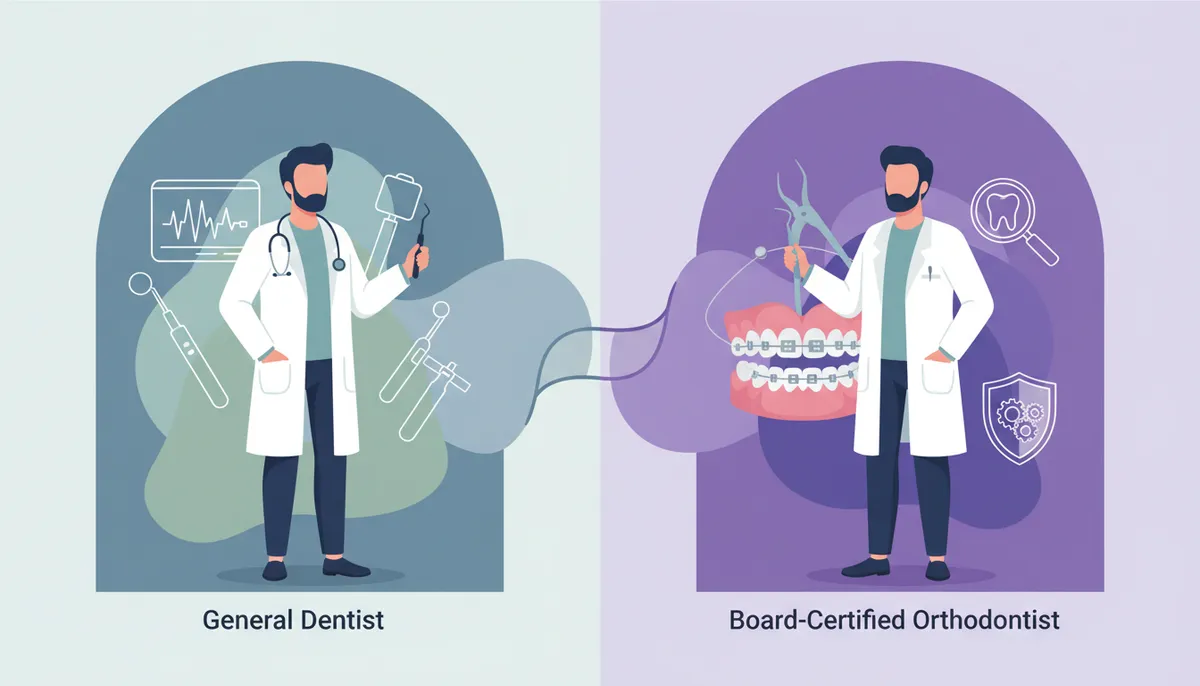
Board Certified vs. Licensed Orthodontist: Key Differences
Many patients assume that all orthodontists are board certified. That is not the case. Here is a side-by-side comparison to clarify the distinction:
| Criteria | Licensed Orthodontist | Board Certified Orthodontist |
|---|---|---|
| Dental Degree (DDS/DMD) | Required | Required |
| Orthodontic Residency (2-3 years) | Required | Required |
| State Licensure | Required | Required |
| ABO Written Examination | Not required | Required |
| Clinical Case Submissions | Not required | Required |
| Oral Examination by Expert Panel | Not required | Required |
| Recertification Every 10 Years | Not required | Required |
| Percentage Who Achieve This | All licensed orthodontists | Fewer than 30% |
As the table shows, board certification requires significant additional effort beyond what state law demands. It is a voluntary pursuit that reflects a deep commitment to professional excellence.
Why Board Certification Matters for Patients
Board certification is more than a credential on a wall. It has real implications for the care you receive. Here is why it matters to you as a patient:
- Higher diagnostic accuracy: Board certified orthodontists are trained to identify complex issues that less specialized providers might miss.
- Better treatment planning: They demonstrate proven ability to plan and manage cases from start to finish with measurable results.
- Ethical standards: The ABO evaluation includes professional ethics as a core component of certification.
- Ongoing education: Recertification every 10 years ensures your provider stays current with the latest techniques and research.
- Confidence in outcomes: Patients can trust that their care is guided by verified clinical skill, not just experience alone.
Whether you are seeking clear aligners, custom braces, or retainers, working with a board certified provider means your treatment plan is based on a higher standard of expertise.
Who Benefits Most From a Board Certified Orthodontist?
Board certification matters for all patients, but it is especially important in certain situations. The following groups benefit most from choosing a board certified provider:
| Patient Group | Why Board Certification Matters | Relevant Treatment |
|---|---|---|
| Young Children (Age 7+) | Early evaluation requires precise diagnostic skill to catch developing issues | Children’s orthodontics |
| Active Teens | Teen cases often involve complex growth patterns and lifestyle needs | Teen braces and aligners |
| Working Adults | Adult cases can involve bone density, jaw alignment, and cosmetic precision | Adult orthodontics |
| Complex Bite Cases | Overbites, underbites, and crossbites require advanced planning | Custom braces, clear aligners |
| Spanish-Speaking Families | Bilingual care ensures clear communication about complex treatment decisions | All orthodontic services |
If you are a parent looking into early orthodontic treatment for your child, choosing a board certified provider can help you avoid costly corrections later. The same applies to adults seeking professional orthodontic solutions that fit their lifestyle and appearance goals.
What ABO Board Certification Covers
Many patients wonder what exactly is tested during the ABO certification process. Here is a summary of the core areas evaluated:
- Orthodontic knowledge: Anatomy, biology, growth and development, biomechanics, and materials science
- Diagnosis and treatment planning: Evaluating X-rays, dental models, and photos to create accurate plans
- Clinical execution: Demonstrating real patient outcomes through documented case studies
- Professional ethics: Upholding standards of honesty, informed consent, and patient-centered care
- Ongoing development: Commitment to staying current through continued education and recertification
This broad evaluation ensures that a board certified orthodontist is qualified to handle everything from simple tooth alignment to complex jaw correction cases. To see the range of treatment options available, explore our advanced orthodontic technology page.
Dr. Omar Chacon: A Board Certified Orthodontist in Westchase and Brandon
Dr. Omar Chacon is a board certified orthodontist with more than 10 years of experience serving patients in Westchase and Brandon, Florida. Originally from Puerto Rico and trained in New York City, Dr. Chacon brings a warm, bilingual approach to every patient interaction — offering care in both English and Spanish.
At Chacon Orthodontics, every patient receives a personalized treatment plan developed using digital 3D exams and modern technology. The practice offers clear aligners, custom braces, retainers, and teeth whitening for children, teens, and adults. Visit us on Google to read reviews from patients across Tampa Bay who trust Dr. Chacon with their smiles.
To learn more about the team behind your care, visit the meet the team page and discover what makes this practice different.
How to Verify If an Orthodontist Is Board Certified
Verifying a provider’s board certification status is simple. Here are the steps you can follow:
- Ask the practice directly. A board certified orthodontist’s office should be able to confirm the status quickly and with confidence.
- Check the ABO website. The American Board of Orthodontics maintains a directory of certified members that is publicly accessible.
- Look for the ABO logo. Many certified orthodontists display the ABO seal on their website, letterhead, and office signage.
- Review the provider’s credentials page. Most qualified providers will list their education, residency, and board certification details on their website’s about or bio page.
If you are unsure where to start, you can also schedule a free consultation at Chacon Orthodontics and speak with Dr. Chacon directly about his credentials and approach to care.
Board Certification and Treatment Options: What to Expect
Choosing a board certified orthodontist does not limit your treatment options — it enhances them. Because board certified providers are evaluated on real clinical outcomes, they are well-equipped to recommend the right approach for your specific needs.
Common treatments offered by board certified orthodontists include:
- Custom metal braces: Durable, effective, and now more comfortable than ever. Ideal for children, teens, and adults with moderate to complex alignment issues. Learn more about custom braces.
- Clear aligners: A discreet option preferred by many teens and adults. Removable trays that gradually shift teeth into position. Explore clear aligner treatment options.
- Retainers: Essential for maintaining results after active treatment. A board certified orthodontist knows exactly when and how to prescribe the right retainer. See our guide on orthodontic retainers.
- Teeth whitening: Many practices offer professional whitening to complete smile transformations. Discover teeth whitening services available at Chacon Orthodontics.
The advantage of working with a board certified provider is the confidence that your treatment plan is backed by verified expertise at every stage — from diagnosis to the final retainer fitting.
Conclusion: Choose Expertise You Can Trust
Choosing an orthodontist is one of the most important healthcare decisions you can make for yourself or your child. Board certification is one of the clearest signals that a provider has gone above and beyond basic requirements to prove their expertise. With fewer than 30% of orthodontists achieving this distinction, it truly sets qualified providers apart.
Whether you are a parent exploring options for your child’s first orthodontic evaluation, a teen looking for braces that fit your lifestyle, or an adult ready to invest in your smile, a board certified orthodontist offers the highest level of clinical assurance available. Read more about what to expect from expert orthodontic care and review patient testimonials from families who have experienced the Chacon Orthodontics difference.
Ready to take the first step toward a healthier, more confident smile? Schedule your complimentary consultation with Dr. Omar Chacon today and experience what board certified orthodontic care truly looks like.
FAQs
Q: What is the difference between an orthodontist and a board certified orthodontist?
A: All orthodontists must complete dental school and a 2-3 year accredited residency program. A board certified orthodontist goes further by voluntarily passing rigorous ABO examinations, submitting clinical case studies, and undergoing oral evaluations — a process that fewer than 30% of orthodontists complete.
Q: Is ABO board certification required to practice orthodontics?
A: No, ABO board certification is entirely voluntary. Orthodontists are only required to hold a state license to practice legally. Board certification represents an additional, self-initiated commitment to demonstrating clinical excellence beyond what licensure requires.
Q: How often must a board certified orthodontist renew their certification?
A: Board certification through the American Board of Orthodontics must be renewed every 10 years. This recertification process ensures that certified orthodontists remain current with the latest advances in orthodontic research, techniques, and standards of care.
Q: How can I verify that my orthodontist is board certified?
A: You can verify board certification by asking the practice directly, checking the ABO’s public directory on their official website, or looking for the ABO seal on the provider’s website or office materials. A board certified provider will typically display these credentials prominently.
Q: Does board certification affect which treatments a provider can offer?
A: Board certification does not restrict treatment options — it validates the expertise behind them. A board certified orthodontist is qualified to offer a full range of treatments including custom braces, clear aligners, and retainers, and their clinical outcomes have been formally reviewed and verified by expert panels.